
Affordable MBBS in Nepal: Guide for Indian Students | Top Admission Consultancy
Looking for an affordable MBBS in Nepal? 🇳🇵 Explore top NMC-approved medical colleges, fee structures, eligibility & the MECEE admission process. Get expert guidance from the premier MBBS admission consultancy in Delhi, India to secure your seat today!
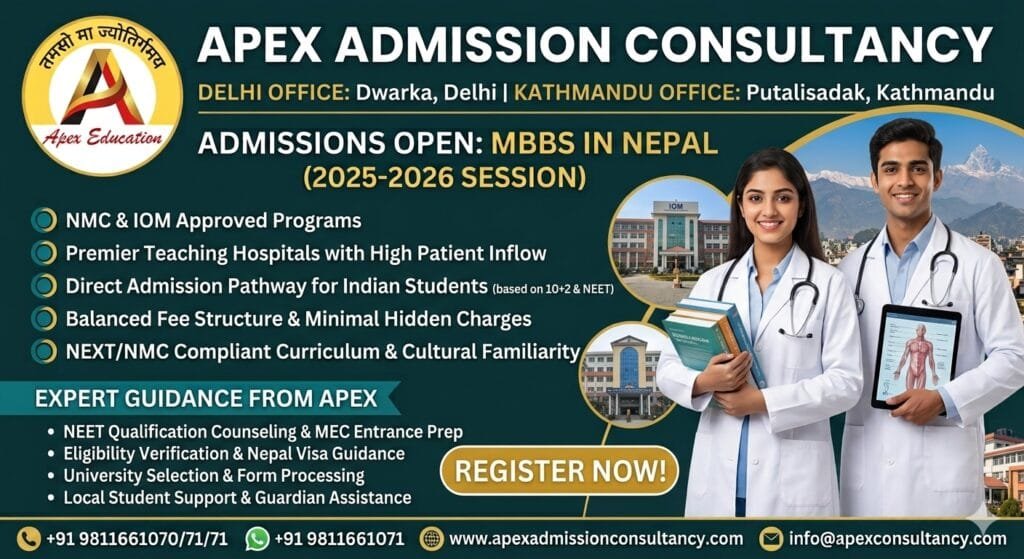
Affordable MBBS in Nepal: The Complete Guide for Indian Medical Aspirants
Pursuing an affordable MBBS in Nepal is one of the most practical, high-yield academic choices for Indian medical aspirants seeking direct NMC compliance, high clinical exposure, and cultural similarity. For Indian students navigating the competitive landscape of the National Eligibility cum Entrance Test (NEET-UG), securing a seat in an Indian government medical college can be exceptionally tough due to high cutoffs and limited seats. Private medical education in India often requires high donations or total budgets reaching INR 90 Lakhs to over 1.2 Crores.
Nepal has emerged as a preferred overseas medical education destination. Boasting an academic framework closely aligned with the National Medical Commission (NMC) guidelines, English-medium curricula, familiar clinical disease patterns, and an open land-border transit system, Nepal bridges affordability and medical rigor.
To help you navigate university selection, eligibility evaluations, and the Medical Education Commission (MEC) entrance pathway, partnering with the best mbbs admission consultancy in Delhi, India provides step-by-step guidance from documentation to hostel check-in.
Why Choose MBBS in Nepal? Key Highlights for Indian Students
Studying medicine across the northern border provides notable geographical, cultural, and pedagogical advantages for Indian students:
- Identical Curriculum & Clinical Spectrum: Nepalese medical colleges follow the British-Indian medical legacy. Medical textbooks by Indian authors (such as OP Ghai for Paediatrics, K.D. Tripathi for Pharmacology, and B.D. Chaurasia for Anatomy) are standard reading. The diseases, epidemic profiles, and clinical presentations match northern, eastern, and central India.
- No Language Barrier: While the official medium of instruction, clinical lectures, and examinations is strictly English, patient interaction occurs in Hindi, Nepali, or Maithili/Bhojpuri. Indian students do not need to learn a non-Indic script or an entirely new tongue (such as Russian, Kazakh, or Mandarin) simply to take a patient history during bedside clinical postings.
- NMC & Global Regulatory Recognition: The MBBS degree offered by Nepalese universities is recognized by the National Medical Commission (NMC) under the Foreign Medical Graduate Licentiate (FMGL) Regulations, listed in the World Directory of Medical Schools (WDOMS), registered with the Educational Commission for Foreign Medical Graduates (ECFMG), and recognized across the UK (GMC – PLAB/UKMLA), Australia (AMC), and Canada (MCC).
- Frictionless Travel & Safety: Indian nationals do not require a visa or a passport to cross the Indo-Nepal border (a valid Voter ID Card or Aadhaar with authorized photo ID suffices, though a passport is best for college documentation). Direct flights connect Delhi to Kathmandu in under 90 minutes, and border districts are easily accessible via road and Indian Railways.
- High Success Rates in Licensing Examinations: Because the syllabus and clinical methods align with Indian standards, graduates from Nepal consistently secure some of the highest passing percentages in the Foreign Medical Graduate Examination (FMGE / NEXT) compared to students returning from China, Russia, or the Philippines.
Connecting with a top mbbs admission consultancy in Delhi, India allows students to match their NEET percentile with college options across Kathmandu, Pokhara, Biratnagar, and Bhairahawa.
Academic Framework & Top Medical Colleges in Nepal
Medical education in Nepal is centrally regulated by the Medical Education Commission (MEC), Government of Nepal. Most institutions operate under two prominent universities: Tribhuvan University (TU) and Kathmandu University (KU), along with autonomous government institutes.
1. Tribhuvan University (Institute of Medicine – IOM)
Established in 1972, the Institute of Medicine (IOM) under Tribhuvan University represents the standard of public clinical training in Nepal. Its teaching wing, Maharajgunj Medical Campus, is affiliated with the Tribhuvan University Teaching Hospital (TUTH).
- Kist Medical College, Lalitpur: Known for modern teaching infrastructure, multi-specialty bedside clinics, and strong diagnostic imaging departments.
- Chitwan Medical College (CMC), Bharatpur: Houses an active tertiary hospital catering to patients across central and southern Nepal, providing extensive clinical case variety.
- National Medical College, Birgunj: Situated right next to the border crossing with Raxaul, Bihar, it serves a heavy clinical patient footfall with an Indian cultural environment.
- Universal College of Medical Sciences (UCMS), Bhairahawa: Located close to the Gorakhpur (UP) border, UCMS is popular among North Indian students due to its accessible location, experienced faculty, and established campus history.
- Gandaki Medical College (GMC), Pokhara: Combines high academic standards with an active hospital setting in the Western region of Nepal.
2. Kathmandu University (KU – School of Medical Sciences)
Kathmandu University oversees a network of private and community medical institutions known for disciplined administrative schedules, modern laboratories, and timely examinations.
- Manipal College of Medical Sciences (MCOMS), Pokhara: Established in 1994, MCOMS Pokhara is one of the most recognized private medical colleges in South Asia. Affiliated with the 750+ bed Manipal Teaching Hospital, it offers an integrated, modern curriculum and attracts a large international student body.
- Kathmandu Medical College (KMC), Kathmandu: Centered in the capital with setups in Sinamangal and Duwakot, KMC combines high patient volumes with advanced research laboratories and strong faculty retention.
- Nepal Medical College (NMC-Nepal), Jorpati, Kathmandu: Renowned for patient inflows from Kathmandu valley and adjoining rural regions, it features specialized units in interventional cardiology, nephrology, and trauma surgery.
- College of Medical Sciences (CMS), Bharatpur: Located in Chitwan, CMS is managed in close connection with Indian healthcare frameworks and offers extensive clinical beds.
- Lumbini Medical College (LMC), Palpa: A tertiary healthcare center serving the western mid-hills, known for diverse pathology cases and structured community medicine postings.
- Nobel Medical College, Biratnagar: Situated near the Jogbani (Bihar) border, this college operates a 900+ bed hospital with active surgical departments.
3. Autonomous Medical Institutions
- B.P. Koirala Institute of Health Sciences (BPKIHS), Dharan: Modeled after AIIMS New Delhi, BPKIHS is an autonomous health sciences university established through Indo-Nepal collaboration. It is one of South Asia’s top clinical training hubs, accepting foreign admissions based on merit through the MEC common entrance.
- Patan Academy of Health Sciences (PAHS), Lalitpur: Focused on public health, emergency care, and community medicine.
Securing a seat in these competitive programs requires step-by-step coordination with a premier mbbs admission consultancy in Delhi, India, particularly during online biometric verification and centralized counseling rounds.
Infrastructure, Clinical Exposure, and Teaching Hospitals
A medical degree is built on clinical bedside practice. Nepalese medical colleges maintain high clinical training standards:
- Bed Capacities & Inflow: NMC and MEC regulations require accredited medical colleges in Nepal to operate functional, licensed multispecialty hospitals with 500 to 1,000+ operational beds. Because government-subsidized care is centered around these university hospitals, general wards see continuous patient turnover for internal medicine, obstetrics/gynecology, trauma surgery, and pediatric care.
- Diagnostic and Laboratory Setups: Anatomy dissection halls feature adequate cadaver-to-student ratios, enabling hands-on surgical dissection rather than reliance on digital simulators. Histology, pathology, microbiology, and biochemistry labs are equipped with high-resolution microscopy, automated analyzers, and culture incubation rooms.
- Library & Digital Subscriptions: Campuses offer 24/7 reading halls, offline reference volumes, and subscriptions to digital indexing databases like PubMed, ClinicalKey, and UpToDate.
- Hostel and Residential Accommodations: For international students, on-campus boarding is typically compulsory. Hostels provide:
- Twin-sharing or single furnished rooms with study desks, wardrobes, and heating provisions for winter months.
- 24/7 campus security, biometric turnstiles, and CCTV surveillance.
- Dining messes managed by student committees or private catering, serving North Indian, South Indian, vegetarian, and non-vegetarian food.
- Continuous water supply, backup generators, and Wi-Fi across hostel blocks.
Total Fee Structure and Financial Comparison
The total cost of studying an MBBS in Nepal typically ranges from INR 45 Lakhs to INR 60 Lakhs (approx. NPR 72 Lakhs to 96 Lakhs) for the complete course duration, inclusive of clinical tuition and university registration. This makes it an affordable alternative to management and NRI quotas in Indian private medical colleges (which often cross INR 85 Lakhs to 1.3 Crores).
Estimated Cost Breakdown (in Indian Rupees – INR)
| Expense Head | Approximate Cost (INR) | Payment Schedule / Notes |
|---|---|---|
| Tuition & University Fees | ₹40,00,000 – ₹52,00,000 | Paid in 3 to 4 annual installments |
| First Year Initial Down Payment | ₹14,00,000 – ₹18,00,000 | Payable at the time of confirmed admission |
| Hostel & Accommodation | ₹80,000 – ₹1,20,000 per year | Varies by room type (AC/Non-AC, Twin/Single) |
| Mess & Food Charges | ₹60,000 – ₹85,000 per year | Payable monthly, quarterly, or annually |
| Registration & University Exam Fees | ₹75,000 – ₹1,50,000 | Paid directly to TU / KU as per exam cycles |
| Total Estimated 5.5-Year Outlay | ₹48,00,000 – ₹60,00,000 | Covers all primary academic and living expenses |
Note: The Nepalese Rupee (NPR) is permanently pegged to the Indian Rupee (INR) at an exchange rate of 1 INR = 1.60 NPR. This currency stability protects Indian parents from the unexpected forex fluctuations common in European or dollar-denominated study destinations.
Working with an expert mbbs admission consultancy in Delhi, India helps families review institutional fee schedules directly, preventing unexpected charges or hidden fees.
Eligibility Criteria & Step-by-Step Admission Procedure
Admission to all medical programs in Nepal is governed centrally by the Medical Education Commission (MEC) in Sanothimi, Bhaktapur.
Academic Eligibility Criteria
- Age Requirement: The candidate must be at least 17 years old on or before December 31 of the admission year.
- Academic Qualifications (10+2 / Higher Secondary):
- Passed Class 12 (or equivalent) with Physics, Chemistry, Biology (PCB), and English.
- Minimum aggregate score of 50% marks in PCB combined (or an equivalent Grade Point Average / Grade C for international boards).
- Minimum 50% individually in each subject (Physics, Chemistry, Biology).
- Qualifying Entrance Exam (NEET-UG): Indian students must be NEET-UG qualified in the relevant academic year. Under current MEC guidelines, an Indian candidate can apply for a foreign category seat through two routes:
- Route A (NEET Pathway): Applying for direct matching through your valid NEET score.
- Route B (MECEE-BL Pathway): Sitting for the Medical Education Commission Entrance Examination for Bachelor Level (MECEE-BL) conducted in Kathmandu. Candidates who sit for the MECEE exam are prioritized during college seat allocations over those applying via NEET scores alone.
Step-by-Step Admission Process
Step 1: NEET-UG Qualification
       │
       ▼
Step 2: MEC Online Application & Biometric Registration
       │
       ▼
Step 3: Document Verification (Eligibility Certificate via MEC Portal)
       │
       ▼
Step 4: Seat Matching, Web-Counseling & Allotment
       │
       ▼
Step 5: Tuition Deposit & Formal Campus Admission
       │
       ▼
Step 6: Hostel Allotment & Class Commencement
- Online MEC Form Filling: When the foreign candidate window opens (typically post-NEET results), register on the MEC web portal.
- Uploading Attested Documents: Submit Class 10 and 12 mark sheets, NEET scorecard, Aadhaar/Passport, and passport-size photographs. Attestation from a notary and an apostille from the Ministry of External Affairs (MEA) may be required.
- Choice Filling (Web Counseling): Rank colleges under Tribhuvan University, Kathmandu University, and autonomous boards based on your score, preferred location, and budget.
- Seat Allotment Order: The MEC releases merit lists and matching rounds. Once a college is allotted, the candidate downloads the Provisional Allotment Letter.
- Initial Fee Transfer: Transfer the university seat-confirmation fee directly via official banking channels (SWIFT/wire transfer from an Indian nationalized bank directly to the assigned university account).
- Campus Verification & Onboarding: Arrive at the college campus in Nepal for physical document verification, health checks, and hostel allocation.
Because registration windows are short and online seat-locking requires strict adherence to timelines, students rely on a prestigious mbbs admission consultancy in Delhi, India to avoid errors during choice-filling and verification.
Detailed Comparative Analysis: Nepal vs. Russia vs. Central Asia
Many Indian students weigh studying in Nepal against medical universities in the Russian Federation or Central Asian republics (Uzbekistan, Kazakhstan, Kyrgyzstan, Georgia). The comparative matrix below highlights key structural differences:
| Evaluation Factor | MBBS in Nepal | MBBS in Russia | MBBS in Central Asia (Uzbekistan, Kazakhstan) |
|---|---|---|---|
| Duration of Course | 4.5 Years + 1 Year Mandatory Internship | 5.8 to 6 Years (Internship often done separately in India) | 5 Years + 1 Year Internship |
| Medium of Instruction | 100% English throughout all clinical & non-clinical years | English for theory; local Russian required for hospital clinical rounds | English for early classes; regional languages needed for clinical years |
| Clinical Language Barrier | None. Hindi and Nepali are widely understood and spoken by patients. | High. Students must learn conversational Russian to take medical histories. | High. Students must communicate in Uzbek, Kazakh, or Russian with patients. |
| Curriculum Standard | Matches Indian medical college syllabi (NMC-aligned, based on Indian reference texts). | Russian Federation State Curricular Standard (varies from Indian models). | Regional medical framework; heavily adapted for test preparation. |
| Disease Spectrum | Tropical, infectious, and lifestyle diseases identical to India. | Arctic, temperate, cold-climate, and localized degenerative pathologies. | Continental interior pathologies; differs from South Asian disease profiles. |
| Average Total Package (Tuition + Living) | ₹48,00,000 to ₹60,00,000 | ₹28,00,000 to ₹45,00,000 | ₹22,00,000 to ₹35,00,000 |
| Proximity & Travel Costs | Direct 1-hour flights or road travel; accessible within a day from Delhi. | Requires 6 to 12 hour multi-leg flights; seasonal airfare costs are high. | Requires 3 to 6 hour flights; moderate airfare. |
| Climate & Food | Similar to Northern India; easy availability of regular Indian food. | Extreme sub-zero winters (-15°C to -30°C); continental food habits. | Cold, dry continental weather; Central Asian diet. |
| FMGE/NEXT Pass Rates | Consistently high among overseas foreign graduates (often 30% to 45%+). | Moderate (historically averaging 15% to 25%). | Historically low to moderate (averaging 10% to 20%). |
While Russia and Central Asia offer lower starting costs, Nepal provides significant advantages in clinical communication, curriculum alignment, and proximity to India. A renowned mbbs admission consultancy in Delhi, India can help you weigh these financial and pedagogical factors based on your career goals.
Validity, Licensing, and Value of the Nepalese Medical Degree
A central concern for medical candidates is whether their foreign degree will remain valid in India and globally.
1. Recognition in India (NMC & FMGL Regulations Compliance)
Under the National Medical Commission’s Foreign Medical Graduate Licentiate (FMGL) Regulations, any foreign MBBS program must fulfill three core criteria to practice in India:
- Course Duration: A minimum of 54 months (4.5 years) of theoretical and clinical instruction.
- Internship: A minimum 12-month continuous, rotating clinical clerkship conducted at the same training hospital where the degree was completed.
- Registration to Practice: The graduate must be eligible for a license to practice medicine in the host country’s domestic jurisdiction.
Medical programs in Nepal fulfill these FMGL provisions:
The MBBS course consists of 4.5 years of classroom and clinical rotations followed by a 1-year compulsory rotating residential internship completed at the attached teaching hospital. Graduates register with the Nepal Medical Council (NMC-Nepal), satisfying Indian licensing requirements and enabling them to sit for the Foreign Medical Graduate Examination (FMGE) or the National Exit Test (NEXT).
The MBBS course consists of 4.5 years of classroom and clinical rotations followed by a 1-year compulsory rotating residential internship completed at the attached teaching hospital. Graduates register with the Nepal Medical Council (NMC-Nepal), satisfying Indian licensing requirements and enabling them to sit for the Foreign Medical Graduate Examination (FMGE) or the National Exit Test (NEXT).
2. International Career Mobility (USMLE, PLAB/UKMLA, AMC)
- United States (USMLE): Nepalese medical colleges are listed in the World Directory of Medical Schools (WDOMS), making students eligible for ECFMG certification, USMLE Step 1, Step 2 CK, and US residency matching.
- United Kingdom (PLAB / UKMLA): The General Medical Council (GMC) accepts primary medical qualifications earned from recognized Nepalese colleges, allowing direct eligibility for the PLAB (or UKMLA) licensing route.
- Australia & Canada: Recognized for AMC (Australia) and MCCQE (Canada) screening evaluations.
To ensure your chosen college maintains up-to-date international listings, seek advice from a trusted mbbs admission consultancy in Delhi, India before submitting your application.
Life as an Indian Student in Nepal: Daily Routine, Culture, and Safety
Adjusting to campus life in Nepal is generally smooth for Indian students due to strong cross-border cultural ties:
- Social Environment: Nepalese communities are welcoming to Indian students, sharing major cultural festivals like Diwali, Holi, Dashain, and Chhath across campuses.
- Food & Dining: Hostels offer regular North and South Indian dining options. Local markets provide the same staples, spices, and groceries found in Indian cities.
- Safety & Security: Campuses operate strict anti-ragging policies, monitored residential complexes, and secure entry points. Towns like Pokhara, Bharatpur, and Lalitpur provide safe, walkable environments for all students.
- Telecommunications & Banking: Indian SIM cards with international roaming work across major cities, and local prepaid SIMs (such as Ncell or Nepal Telecom) can be purchased using your Indian passport or Voter ID. Financial transactions are straightforward: Indian SBI account holders can access funds easily via Nepal SBI Bank branches located nationwide.
Navigating Admissions with Professional Consultancy Support
Applying for foreign medical admissions requires navigating multiple regulatory bodies, including state boards, the Indian National Medical Commission, and Nepal’s Medical Education Commission. Minor errors during MECEE matching, document translation, or bank wire processing can jeopardize a student’s seat.
Working with an experienced admission advisor provides:
- Accurate Profile Matching: Assessing your NEET percentile to identify viable college options across TU, KU, and autonomous universities.
- Transparent Fee Clearances: Reviewing official fee schedules to prevent hidden costs, undocumented charges, or predatory agent fees.
- MEC Portal Management: Handling online application portals, notary documentation, MEA apostille approvals, and web-counseling rounds.
- End-to-End Logistical Support: Assisting with transit, cross-border formalities, campus hostel allotment, and local onboarding.
Whether you need support with entrance registration or private seat counseling, working with an established mbbs admission consultancy in Delhi, India helps streamline your admission journey.
Frequently Asked Questions (FAQs)
1. Is NEET compulsory for Indian students to study MBBS in Nepal?
Yes. NEET qualification is mandatory under National Medical Commission (NMC) regulations to ensure your degree remains valid for the FMGE/NEXT licensing exam in India. You must qualify in NEET during the admission year or qualify for the MECEE exam conducted by the Government of Nepal.
2. What is the total cost of studying MBBS in Nepal?
The total cost typically ranges between INR 45 Lakhs and INR 60 Lakhs, covering 4.5 years of tuition, laboratory charges, and university examination fees. Hostel and dining expenses average an additional INR 1.2 to 1.8 Lakhs per year, depending on the city and room configuration.
3. Does an Indian student need a passport or visa to study in Nepal?
Indian citizens do not need a visa to enter or study in Nepal. While you can travel using a valid Voter ID Card, a valid Indian Passport is recommended for academic records, institutional registrations, and verification with the Medical Education Commission (MEC).
4. Is the internship done in Nepal recognized by the NMC in India?
Yes. The 12-month rotating internship completed at your teaching hospital in Nepal fulfills the NMC’s Foreign Medical Graduate Licentiate (FMGL) regulations. Graduates can sit for the FMGE/NEXT examination upon returning to India without repeating their core internship abroad, though they must complete local registration protocols.
5. What is the medium of instruction in Nepalese medical colleges?
The medium of instruction is entirely English. All lectures, textbooks, clinical rounds, and written examinations are conducted in English.
6. Can graduates from Nepal practice medicine in other countries like the US or UK?
Yes. Because recognized Nepalese medical colleges are listed in the World Directory of Medical Schools (WDOMS) and verified by the ECFMG, graduates can take international licensing exams such as the USMLE (USA), PLAB/UKMLA (UK), and AMC (Australia).
7. How does clinical exposure in Nepal compare to Russia or Central Asia?
Nepal offers a notable advantage in practical clinical exposure. Diseases and patient demographics mirror those in northern and eastern India, and there is no language barrier. Students converse naturally with patients in Hindi, Nepali, or regional dialects, ensuring real bedside learning rather than passive observation.
Final Thoughts: Securing Your Medical Career
Securing an MBBS seat in Nepal provides Indian students with a balanced path to becoming a doctor: full NMC compliance, an English-medium curriculum, familiar clinical training, and reasonable fee structures without excessive private donations.
For tailored counseling on the upcoming MEC intake, cutoff trends, and college comparisons, connect with the best mbbs admission consultancy in Delhi, India to begin your medical education journey with clarity and confidence.
Contact our Delhi Admissions Office today for personalized MECEE profile evaluations, tuition fee breakdowns, and step-by-step guidance.