
Affordable MBBS in China: Indian Student Guide | Top Admission Consultancy
Looking for an affordable MBBS in China? 🇨🇳 Explore top MOE-approved English-medium medical universities, fee packages, eligibility, & X1 visa steps. Contact the premier MBBS admission consultancy in Delhi, India to secure your seat today!
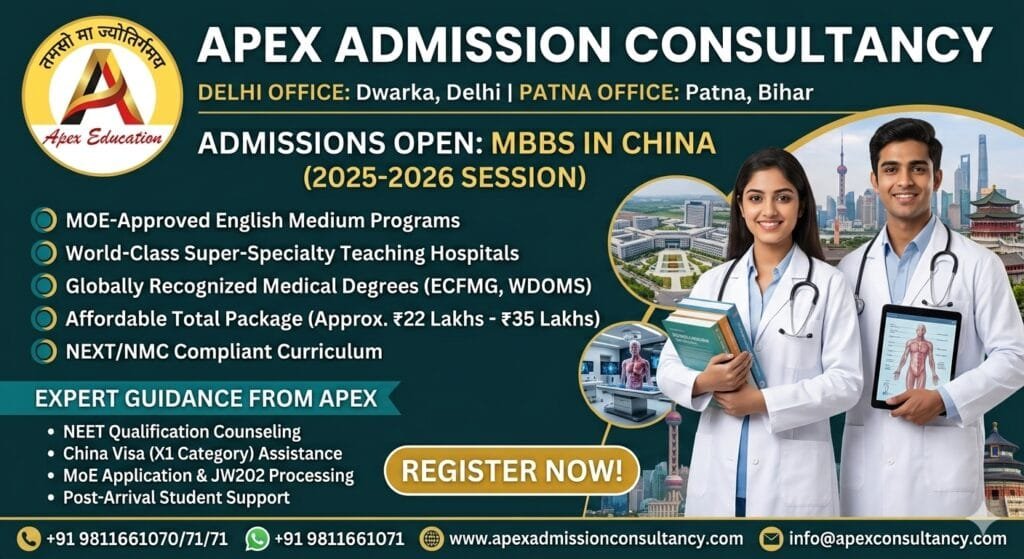
Affordable MBBS in China: The Complete Guide for Indian Medical Aspirants
Pursuing an affordable MBBS in China remains a premier choice for Indian medical aspirants seeking world-class infrastructure, high-tech clinical laboratories, globally ranked universities, and a structured medical education system. For Indian students navigating the intensely competitive National Eligibility cum Entrance Test (NEET-UG), securing a seat in a government medical college can feel nearly impossible. With private medical seats in India demanding high capital donations or annual tuitions that push the total budget past INR 85 Lakhs to 1.3 Crores, looking abroad is no longer just an option—it is a necessity.
China has strategically built a reputation as a global hub for medical pedagogy. Operating under the rigorous supervision of the Ministry of Education (MOE) of the People’s Republic of China, select English-medium medical universities offer premier medical education. These programs combine traditional clinical training with advanced technological infrastructure, such as 3D digital anatomy tables and advanced robotic surgery centers, all at a fraction of the cost of private Indian colleges.
To navigate the strict bilingual mandates, centralized university application portals, and MoE quotas, partnering with the best mbbs admission consultancy in Delhi, India provides step-by-step guidance from your initial application to campus registration.
Why Choose MBBS in China? Key Highlights for Indian Students
For an Indian student comparing global options, China provides an unmatched balance of technological sophistication, global prestige, and institutional scale:
- MOE-Approved English-Medium Programs: The Chinese Ministry of Education officially publishes a strict, limited list of universities approved to teach MBBS in English. This structure ensures that international students receive standardized instruction from highly qualified professors, without facing the risk of unexpected shifts to regional languages mid-course.
- World-Class Infrastructure and Super-Specialty Hospitals: Chinese medical institutions operate on an immense scale. The affiliated teaching hospitals are massive medical centers with 1,500 to over 3,000 beds. They feature modern medical technology, including advanced MRI systems, fully automated pathology lines, gene sequencing labs, and telemedicine centers.
- Global Credibility and Valued Degree: Medical universities in China are listed in the World Directory of Medical Schools (WDOMS), registered with the ECFMG (USA), and recognized by the Foundation for Advancement of International Medical Education and Research (FAIMER). This global recognition opens pathways to licensing exams like the USMLE (USA), PLAB/UKMLA (UK), and AMC (Australia).
- High Success Rates in Global Screening Exams: The curriculum aligns with international standards, emphasizing strong conceptual foundations in basic medical sciences and clinical skills. This helps graduates achieve high success rates in licensing exams like the FMGE and the upcoming National Exit Test (NEXT) in India.
- Safe, Modern Campus Living: China is globally recognized for its exceptional safety standards and modern infrastructure. Medical campuses function as fully contained, high-security student townships, complete with digital access systems, on-campus banking, and high-speed transit networks.
Consulting a top mbbs admission consultancy in Delhi, India enables families to select institutions that perfectly match their academic backgrounds and financial goals.
The Academic Framework & MOE-Accredited Medical Universities
Medical programs in China operate under a standardized 6-year structural framework: 5 years of academic and clinical training followed by a 1-year compulsory rotating clinical internship. The entire curriculum is centrally monitored to maintain quality across every semester.
The standard of education varies by university tier, as outlined below:
1. Tier-1 MOE-Approved English-Medium Universities
These are elite institutions funded directly by national education initiatives (such as Double First-Class University plans). They have limited international seat quotas and require high high-school aggregates:
- Zhejiang University (ZJU), Hangzhou: Consistently ranked among the top universities globally, ZJU features an elite medical school, advanced research institutes, and multiple massive affiliated teaching hospitals, providing exceptional clinical case exposure.
- Xi’an Jiaotong University (XJTU), Xi’an: Known for its rigorous academic history, modern campus infrastructure, and a large, active community of international students.
- Sichuan University, Chengdu: West China School of Medicine under Sichuan University is a historically significant center for medical training, famous for its deep clinical case varieties and exceptional pathology units.
- Huazhong University of Science and Technology (HUST), Wuhan: Tongji Medical College under HUST is globally renowned for its advanced medical research, highly published faculty, and expansive clinical centers.
- Jilin University, Changchun: Norman Bethune Health Science Center under Jilin University is a popular option among Indian students due to its balance of stable tuition rates and excellent laboratory setups.
2. Premium State-Level Medical Universities
These institutions specialize primarily in health sciences and clinical medicine, offering high-quality clinical training at an accessible tuition level:
- China Medical University (CMU), Shenyang: One of the earliest medical schools in China, CMU offers an entire campus dedicated to health sciences, exceptional library systems, and comprehensive English-taught clinical tracks.
- Dalian Medical University, Dalian: Located in a beautiful coastal city, this university is highly popular due to its excellent, modern international student apartments, dedicated Indian messes, and extensive history of training foreign graduates.
- Nanjing Medical University, Nanjing: Known for its central location, modern research facilities, and close administrative tracking of students’ international board performance.
- Kunming Medical University, Kunming: Situated in the south-central region with a pleasant climate, it offers an identical tropical disease spectrum that aligns closely with South Asian medical contexts.
Securing a seat in these competitive programs requires step-by-step coordination with a premier mbbs admission consultancy in Delhi, India, particularly during early online portal submissions and localized document verification rounds.
Infrastructure, Advanced Laboratories, and Teaching Hospitals
The clinical training facilities in China are built to look like advanced research cities. They provide a level of practical experience that is difficult to find elsewhere:
- Massive Hospital Capacities: A standard teaching hospital affiliated with a Chinese medical university handles thousands of outpatients daily. International students complete clinical rotations across active departments, including neurosurgery, interventional cardiology, neonatal intensive care units (NICU), and complex trauma units.
- Advanced Simulation and Anatomy Suites: China leads in integrating digital technologies into medical education. Students train using high-tech virtual reality simulation labs, practice surgical suturing on digital modules, and study structural pathology using advanced 3D digital cadaver tables alongside traditional human dissection.
- Comprehensive Libraries: Campus libraries are architectural landmarks, providing multi-story reading zones, extensive physical text collections, and unlimited access to international medical databases like Elsevier, SpringerLink, and Ovid.
- Hostel Accommodations and On-Campus Living: International student dormitories are designed to provide a comfortable, high-quality living environment:
- Safe twin-sharing or single rooms equipped with private attached bathrooms, individual study desks, wardrobes, and central heating or air conditioning.
- Common kitchen blocks on each residential floor equipped with induction cooktops, ovens, and refrigerators, allowing students to prepare their own meals.
- Dedicated on-campus international student dining halls serving authorized Indian vegetarian and non-vegetarian meals prepared by trained cooks.
- 24/7 security desks, card-swipe entry turnstiles, high-speed campus Wi-Fi networks, and complete access to modern laundry facilities.
Comprehensive Fee Structure and Financial Breakdown
The total tuition and accommodation cost for an MBBS program in China ranges from RMB 30,000 to RMB 45,000 per year (approx. INR 3.5 Lakhs to INR 5.3 Lakhs annually). Over the complete 6-year duration, the total academic package averages INR 22 Lakhs to INR 35 Lakhs, making it an affordable alternative for families seeking a high-tier international degree.
Estimated Cost Breakdown (in Chinese Yuan – RMB & Indian Rupees – INR)
| Academic / Living Expense Category | Annual Cost in Chinese Yuan (RMB) | Annual Cost in Indian Rupees (INR) | Payment Scheduling / Key Notes |
|---|---|---|---|
| Annual Tuition Fees (Tier 2 to Tier 1) | ¥30,000 – ¥45,000 | ₹3,50,000 – ₹5,30,000 | Paid directly to the university account at the start of each year |
| Campus Accommodation / Hostel Fee | ¥4,000 – ¥8,000 | ₹48,00,0 – ₹95,000 | Covers twin-sharing rooms; paid annually on-site |
| Medical Insurance & Residence Permit | ¥1,400 – ¥2,000 | ₹16,000 – ₹24,000 | Mandatory annual statutory compliance cost inside China |
| Textbooks & Laboratory Materials | ¥500 – ¥1,000 | ₹6,000 – ₹12,000 | Variable out-of-pocket costs based on semester needs |
| Food & Monthly Mess Living Expenses | ¥800 – ¥1,200 / month | ₹9,500 – ₹14,000 / month | Paid monthly based on individual dietary habits |
| Total Estimated 6-Year Outlay Package | ¥2,30,000 – ¥3,20,000 | ₹27,00,000 – ₹38,00,000 | Covers all primary tuition, lodging, and essential costs |
Note: The currency conversions are calculated at an estimated baseline of 1 RMB = 11.80 INR. While the Chinese Yuan remains stable, families are advised to account for minor currency market variations over the 6-year duration.
Working closely with an expert mbbs admission consultancy in Delhi, India ensures that parents receive clear institutional fee charts, protecting them from hidden agent margins, sudden currency exchange penalties, or unexpected processing fees.
Eligibility Criteria & Step-by-Step Admission Procedure
Admissions to MOE-approved English-medium medical programs in China follow strict academic standards. The process is competitive, and seats are allocated based on your academic profile.
Academic Eligibility Criteria
- Age Requirement: The applicant must be between 18 and 25 years old at the time of formal enrollment.
- High School Academic Performance (10+2 / Higher Secondary):
- Must have completed Class 12 with Physics, Chemistry, Biology (PCB), and English.
- A minimum aggregate score of 60% to 75%+ in PCB subjects combined (Tier-1 universities require higher aggregates, often above 80%).
- A minimum score of 60% individually in English, as the program is taught entirely in English.
- NEET-UG Qualification: The applicant must possess a valid, qualifying NEET-UG scorecard for the relevant academic cycle to satisfy the requirements of the Indian National Medical Commission.
Step-by-Step Admission Process
Step 1: Document Compilation & Verification (Transcripts, Passport, Physical Fitness)
       │
       ▼
Step 2: Submission via the University's Digital Portal / JW202 Processing
       │
       ▼
Step 3: Academic Interview / Institutional Entrance Evaluation
       │
       ▼
Step 4: Issuance of Official Admission Notice & Electronic JW202/JW201 Form
       │
       ▼
Step 5: Visa Application Submission (Category-X1 Student Visa) at the Chinese Embassy
       │
       ▼
Step 6: Flight Clearance, Campus Onboarding, Medical Exam & Hostel Check-in
- Document Preparation: Gather your Class 10 and 12 mark sheets, a valid passport, a clean police clearance certificate (PCC), passport-size photographs with white backgrounds, and a completed Foreigner Physical Examination Form signed by a registered government doctor.
- Portal Submission: Submit your documents through the university’s digital portal. The university review board evaluates your high school scores and language proficiency.
- Institutional Interview: Many top-tier universities conduct a brief online video interview or basic entrance assessment covering foundational biology and chemistry concepts.
- JW202 Document Generation: Once accepted, the university issues a formal Admission Letter and uploads your profile to the Ministry of Education to generate the JW202 Form (Visa Application Form for Study in China). This document is essential for your visa process.
- Visa Stamping: Submit your original Admission Notice, JW202 Form, passport, and medical records to the Chinese Embassy or designated Visa Application Service Center to obtain an X1 Student Visa.
- Campus Registration: Arrive at the university campus before the formal registration deadline to complete document checks, undergo a local health evaluation, pay your tuition fees, and move into your hostel.
Because the JW202 form generation follows a strict schedule and universities have limited international seat quotas, students rely on a prestigious mbbs admission consultancy in Delhi, India to avoid errors during the portal application window.
Head-to-Head Comparative Matrix: China vs. Russia vs. Central Asia vs. Nepal
Choosing the right study destination requires a careful look at academic systems, clinical opportunities, and financial paths. The table below provides a detailed comparison across popular choices:
| Evaluation Criteria | MBBS in China | MBBS in Russia | MBBS in Central Asia | MBBS in Nepal |
|---|---|---|---|---|
| Duration of Program | 5 Years Classwork + 1 Year Mandatory Internship | 5.8 to 6 Years Total Duration | 5 Years Classwork + 1 Year Internship | 4.5 Years Classwork + 1 Year Internship |
| MOE / State Supervision | Strictly Regulated. The Ministry of Education enforces high standards for English-medium tracks. | Varies; individual university councils determine language policies. | Regional management systems; varying degrees of infrastructure support. | Strictly Regulated. Regulated centrally by the Medical Education Commission (MEC). |
| Campus Infrastructure | Exceptional. High-speed research parks, advanced digital labs, and extensive libraries. | Traditional classical university layouts; older building structures. | Standard functional facilities; focused primarily on classroom learning. | Modern clinical campus layouts; compact, dedicated medical blocks. |
| Clinical Language Requirement | Mandatory Bilingual Track. Conversational Chinese is required to interact with patients during clinical years. | Conversational Russian is required for hospital clinical postings. | Local languages (Kazakh, Uzbek, Kyrgyz) are required for bedside histories. | None. Patients understand and speak Hindi, Nepali, or regional dialects. |
| Disease Spectrum | East Asian, modern lifestyle, infectious, and degenerative pathologies. | Arctic, temperate, cold-climate, and localized northern illnesses. | Continental dry-interior pathologies and public health cases. | Tropical, infectious, and community illnesses identical to India. |
| Average Total Package Cost | ₹22,00,000 to ₹38,00,000 | ₹28,00,000 to ₹45,00,000 | ₹22,00,000 to ₹35,00,000 | ₹48,00,000 to ₹60,00,000 |
| FMGE/NEXT Performance | Stable results; graduates generally show high passing rates due to strong basics. | Variable results; depends heavily on the student’s personal preparation. | Moderate results; requires significant external coaching support. | Consistently high passing rates due to identical curriculum layouts. |
While Nepal provides an open border and no language barrier, China offers an exceptional standard of infrastructure, advanced digital laboratories, and global university rankings within a highly competitive budget. A renowned mbbs admission consultancy in Delhi, India can help you evaluate these financial and academic trade-offs based on your career goals.
Validity, Licensing, and Value of a Chinese Medical Certificate
A major priority for medical aspirants is ensuring their international degree remains valid for future career options.
1. Recognition in India (NMC Compliance Standards)
To satisfy the National Medical Commission’s Foreign Medical Graduate Licentiate (FMGL) Regulations, an overseas medical program must provide:
- A continuous course duration of at least 54 months of medical study.
- A mandatory 12-month rotating clinical internship completed at the attached university teaching hospital.
- A valid license to practice medicine within the host country’s domestic jurisdiction.
Chinese English-Medium MBBS programs fulfill these regulations:
The curriculum provides 5 years (10 semesters) of academic study followed by a 1-year rotating clinical clerkship. Furthermore, universities assist graduates in taking the HSK (Chinese Language Proficiency Exam) up to level 4 or 5, allowing them to participate fully in clinical work and satisfy host-country registration standards. This qualifies them to sit for the FMGE or National Exit Test (NEXT) in India.
The curriculum provides 5 years (10 semesters) of academic study followed by a 1-year rotating clinical clerkship. Furthermore, universities assist graduates in taking the HSK (Chinese Language Proficiency Exam) up to level 4 or 5, allowing them to participate fully in clinical work and satisfy host-country registration standards. This qualifies them to sit for the FMGE or National Exit Test (NEXT) in India.
2. International Career Pathways (USMLE, PLAB/UKMLA)
- United States (USMLE): Because top-tier Chinese medical institutions are registered with FAIMER and listed in the World Directory of Medical Schools, students can complete ECFMG verification and take USMLE Step 1 and Step 2 CK to enter the US residency matching system.
- United Kingdom (PLAB/UKMLA): The General Medical Council (GMC) accepts primary qualifications from approved Chinese universities, allowing graduates to register for the PLAB/UKMLA examination pathway.
To ensure your chosen university maintains all necessary international listings, consult a trusted mbbs admission consultancy in Delhi, India before submitting your application files.
Life as an Indian Student in China: Safety, Language, and Adaptation
Living on a campus in China offers a unique opportunity to experience a modern, multicultural environment:
- The Bilingual Track: Although your lectures, exams, and medical textbooks are entirely in English, learning conversational Chinese (Mandarin) is integrated into your early years. This training is essential for daily life outside campus and ensures you can communicate naturally with patients during your clinical rotations.
- Safety Standards: Campus townships implement strict access controls, visitor screening, and professional security management, providing a safe and focused learning environment for all students.
- Food & Dining Options: University cafeterias feature dedicated international dining halls with professional cooks preparing Indian dishes. Additionally, common kitchen blocks in the hostels allow students to cook their own meals using ingredients from local supermarkets.
- Digital Convenience: China operates on an advanced cashless economy. Using applications like WeChat Pay or Alipay, students can manage daily expenses, buy books, pay utilities, and book transit tickets directly from their smartphones.
Navigating Admissions with Professional Consultancy Support
Applying for admission to a top-tier Chinese medical university requires precise coordination across digital university portals, embassy validation desks, and ministry channels. Missing a application deadline or making an error on your visa application can delay your enrollment by an entire academic year.
Partnering with an experienced educational advisor provides:
- Accurate University Matching: Evaluating your Class 12 biology scores and NEET percentile to identify the right match among MOE-approved English-medium programs.
- JW202 Document Tracking: Managing the collection of your files and tracking your profile through the Ministry of Education to ensure your visa documents are processed correctly.
- Transparent Financial Planning: Reviewing official university fee schedules directly to protect you from unexpected mid-course fees or hidden agent margins.
- Logistical Onboarding Support: Assisting with group flight bookings, visa applications at the embassy, land transit coordination, and hostel check-in.
Whether you need support with entrance registration or university profiling, working with an established mbbs admission consultancy in Delhi, India helps ensure a well-guided path toward your medical degree.
Frequently Asked Questions (FAQs)
1. Is NEET qualification required for Indian students to study MBBS in China?
Yes. Under National Medical Commission (NMC) regulations, every Indian student planning to pursue an undergraduate medical course abroad must be NEET-UG qualified to remain eligible for licensing exams back in India.
2. What is the total cost of studying an MBBS in China?
The total academic tuition and hostel fees range from INR 22 Lakhs to INR 38 Lakhs for the full 6-year duration, depending on the university’s tier and location. Monthly food and personal living expenses typically average an additional INR 10,000 to INR 14,000.
3. Are all Chinese medical universities approved to teach in English?
No. The Chinese Ministry of Education (MOE) publishes a strict, limited list of universities authorized to offer the MBBS curriculum in English to international students. Applying to an unlisted university may mean your classes are taught in Chinese, which can affect your degree’s validity back home.
4. Is the Chinese language hard to learn for international medical students?
Foundational medical terms and daily conversational Mandarin are taught systematically during your first two years. This structured approach helps students pick up the language naturally, ensuring they can communicate comfortably during clinical rotations.
5. Can I complete my 1-year clinical internship in India instead of China?
To satisfy current NMC FMGL regulations, you must complete your complete 12-month rotating internship at the attached teaching hospital of your host university. Completing it outside the host institution can affect your eligibility for local medical registration.
6. What visa do I need to travel and study on a campus in China?
You must apply for an X1 Student Visa at the Chinese Embassy or designated visa center in India. This visa requires your original passport, a formal Admission Notice from the university, and your official government-issued JW202/JW201 Form.
7. How does the infrastructure in China compare to European medical colleges?
Chinese medical universities feature state-of-the-art infrastructure. Their campuses operate like large research parks, offering advanced virtual reality simulation facilities, multi-story digital libraries, and massive multi-specialty teaching hospitals that often exceed the clinical scale of standard European institutions.
Final Thoughts: Building a Foundation for Your Medical Career
Pursuing an MBBS in China offers Indian students a balanced combination of advanced technological infrastructure, globally recognized degrees, safe campus communities, and affordable tuition options without the burden of private seat capitation fees.
For tailored guidance on the upcoming MOE intakes, university cutoffs, and application steps, contact a best mbbs admission consultancy in Delhi, India today to plan your medical education journey with clarity and confidence.
Contact our Delhi Admissions Office today to receive a personalized profile evaluation, a verified breakdown of university fees, and step-by-step guidance for the upcoming intake.