
Affordable MBBS in Bangladesh: Indian Student Guide | Top Admission Consultancy
Looking for an affordable MBBS in Bangladesh? 🇧🇩 Explore top NMC-compliant medical colleges, complete fee structures, GPA eligibility, & the DGME process. Contact the premier MBBS admission consultancy in Delhi, India to book your seat!
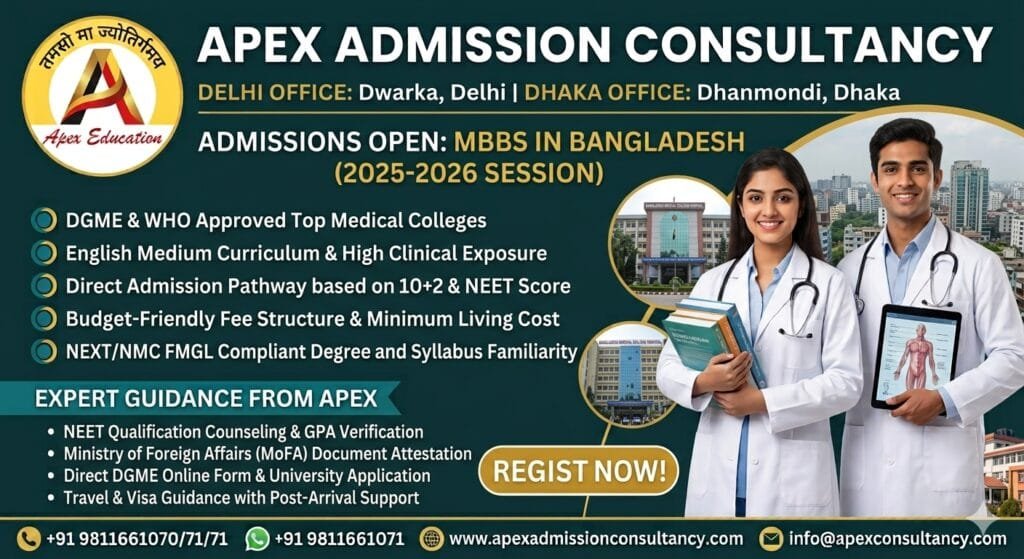
Affordable MBBS in Bangladesh: The Complete Guide for Indian Medical Aspirants
Pursuing an affordable MBBS in Bangladesh has become one of the most reliable and highly sought-after academic paths for Indian medical aspirants, offering 100% compliance with NMC regulations, exceptionally high clinical patient exposure, and a familiar epidemiological environment. Facing an incredibly competitive environment in the National Eligibility cum Entrance Test (NEET-UG), thousands of qualified Indian students fall short of government cutoffs. Meanwhile, the staggering capital outlays required by Indian private colleges—often ranging from INR 85 Lakhs to well over 1.2 Crores—put quality medical education out of reach for middle-class families.
Bangladesh presents a highly strategic alternative. It offers rigorous medical education through institutions recognized by the World Health Organization (WHO) and the National Medical Commission (NMC). Its syllabus aligns with the British-Indian curriculum legacy, and it boasts a notable safety record, comfortable hostel setups, and affordable fee packages.
To navigate the strict eligibility calculations, university validation protocols, and the Director General of Medical Education (DGME) centralized counseling system, seeking assistance from the best mbbs admission consultancy in Delhi, India provides end-to-end guidance from preliminary application verification to campus hostel check-in.
Why Choose MBBS in Bangladesh? Key Highlights for Indian Students
For Indian students evaluating international medical education options, Bangladesh offers structural, academic, and geographical advantages that distinguish it from alternative overseas destinations:
- Complete NMC FMGL Compliance: The modern 5-year MBBS syllabus combined with a mandatory 1-year clinical internship satisfies the strict requirements of the National Medical Commission’s Foreign Medical Graduate Licentiate (FMGL) Regulations. Degrees earned in Bangladesh are completely eligible for the National Exit Test (NEXT) and Foreign Medical Graduate Examination (FMGE) licensing pathways.
- Exceptional Patient Inflow and Tropical Pathology: Unlike many colder foreign study destinations, Bangladesh’s clinical environment shares an identical disease spectrum with India. Students learn bedside medicine by diagnosing infectious diseases, tropical epidemics, lifestyle disorders, and community health patterns that exactly mirror the pathology they will treat when returning to practice in India.
- English-Medium Curriculum & High Passing Rates: Textbooks written by celebrated South Asian medical authors are foundational reading in Bangladesh. All theoretical classes, clinical lectures, laboratory exams, and professional board examinations are conducted strictly in English. Consequently, graduates from Bangladesh regularly secure some of the highest passing percentages in the FMGE screening tests compared to other foreign regions.
- Minimal Language Barrier during Clinical Rounds: While academic assessments are held in English, patients in hospital wards communicate primarily in Bengali. For students from West Bengal, Assam, Tripura, or those fluent in Hindi, conversational communication is straightforward. The linguistic transition is significantly smoother than learning entirely new scripts or languages like Russian, Kazakh, or Mandarin just to take basic patient history.
- Cultural and Dietary Familiarity: Moving to a foreign country often causes lifestyle adjustments. Bangladesh shares culinary habits, cultural values, and weather conditions with Eastern and Northern India, meaning students have easy access to standard vegetarian and non-vegetarian Indian meals without experiencing severe culture shock.
Consulting a top mbbs admission consultancy in Delhi, India helps students evaluate their NEET qualification details against specific vacancy matrices across top-tier colleges in Dhaka, Chittagong, Sylhet, and Rajshahi.
Academic Framework & Regulatory Topography
Medical programs in Bangladesh operate under a centralized structure overseen by the Ministry of Health and Family Welfare (MoHFW) and the Director General of Medical Education (DGME). The individual teaching campuses are administratively affiliated with prominent state universities that conduct examinations and award final medical degrees.
1. University of Dhaka
The University of Dhaka oversees a large network of highly regarded private and public medical colleges. These campuses are located within or near the capital territory, ensuring steady clinical patient numbers.
- Dhaka National Medical College (DNMC): Situated in Old Dhaka, DNMC has a rich historical legacy dating back to 1925. It boasts an attached 850+ bed multidisciplinary teaching hospital, an expansive modern library, and a large community of Indian students.
- Bangladesh Medical College (BMC), Dhanmondi: As the first private medical college in Bangladesh, BMC is a benchmark for quality medical education. It is recognized for its high academic standards, clinical research facilities, and experienced senior professors.
- Holy Family Red Crescent Medical College, Dhaka: Managed by the Bangladesh Red Crescent Society, this institution is known for its disciplined administrative structure, modern laboratory facilities, and an adjacent hospital with an active emergency trauma wing.
- Anwer Khan Modern Medical College (AKMMC), Dhanmondi: Located in a central healthcare hub, AKMMC operates a well-equipped super-specialty hospital with modern diagnostic suites.
- Popular Medical College, Dhaka: Renowned for integrated lecture halls and high patient volumes in its diagnostic outpatient clinics.
2. University of Chittagong (Chittagong Medical University)
Institutions affiliated with this university serve the southeastern coastal and hill tracts, providing exposure to distinct regional epidemiological and public health cases.
- Chittagong International Medical College (CIMC): Known for structured academic programs, modern computer laboratories, and a campus focused on healthcare quality benchmarks.
- Eastern Medical College (EMC), Comilla: Located strategically near the main highway connecting Dhaka and Chittagong, EMC operates an active tertiary care hospital serving a large regional population, offering excellent clinical exposure.
- Central Medical College (CEMECO), Comilla: Features well-designed anatomy dissection units and multi-disciplinary pathology laboratories.
- Mainamoti Medical College, Comilla: Offers an accessible campus layout, reliable hostel accommodations, and an adjacent general hospital setup.
3. Rajshahi Medical University & University of Rajshahi
Serving the northern and western administrative divisions of Bangladesh, these colleges are popular among Indian students due to their affordable fee structures and proximity to the land border checkpoints of West Bengal.
- Khwaja Yunus Ali Medical College (KYAMC), Sirajganj: Designed as a fully self-contained corporate medical township, KYAMC features an advanced 580-bed multi-disciplinary super-specialty hospital, an integrated oncology center, and modern residential facilities for international students.
- Barind Medical College, Rajshahi: Known for a modern campus layout, regular clinical field research postings, and structured academic tracking.
- TMSS Medical College, Bogra: One of the largest private medical colleges in northern Bangladesh, managed by an established non-governmental organization, operating an active 750+ bed hospital.
4. Shahjalal University of Science and Technology (SUST) / Sylhet Medical University
These institutions serve the northeastern tea-plantation districts and are recognized for their clinical casework and calm campus environments.
- Jalalabad Ragib-Rabeya Medical College (JRRMC), Sylhet: Features an expansive 900+ bed fully operational teaching hospital, providing extensive bedside learning opportunities for medical students.
- Sylhet Women’s Medical College (SWMC): A dedicated medical institution providing secure, state-of-the-art campus and boarding facilities exclusively for female medical aspirants.
Navigating these university choices requires careful coordination with a premier mbbs admission consultancy in Delhi, India, specifically during the calculation of GPA eligibility and the submission of documents to the Bangladesh High Commission.
Infrastructure, Clinical Exposure, and Teaching Hospitals
The clinical competence of a doctor depends on hands-on practice. Medical colleges in Bangladesh place a strong emphasis on practical, hospital-based learning over simulated learning:
- Clinical Ward Postings and Patient Footfall: Affiliated teaching hospitals generally maintain between 500 and 1,000+ operational beds with high occupancy rates. Because healthcare fees are subsidized, hospitals see a continuous inflow of patients, allowing students to participate directly in diagnosing case histories, observing surgical procedures, and assisting during emergency rotations.
- Anatomy Dissection Halls and Practical Labs: Dissection rooms utilize real human cadavers under controlled teacher-to-student ratios, ensuring students gain a foundational understanding of structural anatomy. Labs for biochemistry, histology, hematology, and microbiology are equipped with high-resolution microscopy and automated chemical counters.
- Libraries and Academic Support: Learning resource centers provide extensive physical textbook collections, quiet study carrels, and high-speed digital access to international medical journals via initiatives like HINARI, PubMed, and institutional network repositories.
- Hostel Amenities & Student Safety: Most private medical colleges in Bangladesh require international students to live in on-campus student housing. These hostels provide:
- Secure, separate residential blocks or designated floors for male and female students, monitored by full-time wardens and 24/7 CCTV surveillance.
- Furnished double or triple sharing rooms equipped with closets, study workstations, and options for climate control.
- Dedicated in-house student kitchens or institutional messes that prepare regular Indian meals, with options for both vegetarian and non-vegetarian preferences.
- Reliable electrical infrastructure, water purification lines, and common recreational or fitness lounges.
Fee Structure and Comprehensive Financial Analysis
The total cost for an MBBS program in Bangladesh ranges from USD 35,000 to USD 48,000 (approx. INR 29 Lakhs to INR 40 Lakhs) for the full 5-year academic course. This inclusive package covers primary tuition fees, laboratory fees, basic library usage, and campus infrastructure development levies, making it an affordable alternative to self-financed private seats in India.
Estimated Expense Outlay Breakdown (in US Dollars & Indian Rupees)
| Fee Component | Cost in US Dollars (USD) | Equivalent in Indian Rupees (INR) | Payment & Structural Terms |
|---|---|---|---|
| Booking & Initial Seat Confirmation Fee | $5,000 – $8,000 | ₹4,15,000 – ₹6,65,000 | Payable immediately upon allocation to secure the seat |
| Remaining Year-1 Balance Fee | $7,000 – $10,000 | ₹5,80,000 – ₹8,30,000 | Cleared upon arrival at the campus during formal registration |
| Years 2 to 5 Annual Installments | $5,50,0 – $7,500 / year | ₹4,55,000 – ₹6,25,000 / year | Paid in equal, structured installments at the start of each academic year |
| Hostel Accommodation Charges | Included in tuition / up to $1,200 / year | Included / up to ₹1,00,000 / year | Varies depending on room type (AC or standard non-AC) |
| Mess & Dining Food Charges | $40 – $60 / month | ₹3,300 – ₹5,000 / month | Paid directly to the student mess committee or local caterer |
| Total 5-Year Academic Outlay | $35,000 – $48,000 | ₹29,00,000 – ₹40,00,000 | Covers the entire academic tuition framework |
Note: Professional university board examination fees (levied by Dhaka University, Chittagong University, etc.) and mandatory clinical internship registration fees are billed separately during the course, usually totaling between USD 500 and USD 1,500 over the 5-year duration.
Working with an expert mbbs admission consultancy in Delhi, India provides families with verified institutional fee sheets, protecting them from unexpected mid-course charges, hidden agent margins, or unrecorded administrative fines.
Eligibility Criteria & Step-by-Step Admission Procedure
Admissions for international students in Bangladesh are strictly merit-based and governed by regulatory standards enforced by the DGME and Ministry of Foreign Affairs (MoFA).
The Mandatory GPA Eligibility Formulation
Bangladesh employs a rigorous calculation system based on Secondary School Certificate (SSC / Class 10) and Higher Secondary Certificate (HSC / Class 12) scores. Meeting these criteria is mandatory:
- No Academic Gap Years Exceeding Limits: Under current DGME guidelines, students must have cleared their Class 12 exams within the immediate or previous academic cycle. Excessive gap years after high school can disqualify an applicant from the formal processing window.
- Minimum Individual and Combined GPA:
- An applicant must secure a minimum GPA of 3.00 out of 5.00 in Class 10 (Secondary level).
- An applicant must secure a minimum GPA of 3.00 out of 5.00 in Class 12 (Higher Secondary level).
- The combined aggregate score across Class 10 and Class 12 must be a minimum GPA of 7.00 out of 10.00.
- Biology-Specific Grade Prerequisite: The student must score a minimum GPA of 3.50 in Biology in Class 12. This means obtaining a minimum of 60% or a corresponding ‘B’ grade in Biology theory and practical assessments combined.
- NEET-UG Qualification: The candidate must be NEET-UG qualified during the current or valid regulatory intake cycle, satisfying the core mandate of the Indian National Medical Commission.
Step-by-Step Admission Flowchart
Step 1: Document Gathering & Attestation (Notary, MEA, High Commission)
       │
       ▼
Step 2: Formal Equivalence Calculation & Submission via DGME Portal
       │
       ▼
Step 3: Receipt of Official Equivalence Certificate & Verification Grade
       │
       ▼
Step 4: Institutional Choice Selection & Allotment Processing
       │
       ▼
Step 5: Ministry of Foreign Affairs (MoFA) Student Clearance Order
       │
       ▼
Step 6: Bank Remittance of First-Year Tuition Fees via Authorized Channel
       │
       ▼
Step 7: Student Visa (Category-T) Stamping & Arrival on Campus
- Document Attestation: Gather Class 10 and 12 mark sheets, passing certificates, birth records, and passports. These must be verified by a notary public, apostilled by the Ministry of External Affairs (MEA), New Delhi, and countersigned by the High Commission of Bangladesh.
- DGME Equivalence Application: Submit the attested documents through the online DGME portal for calculation. The DGME processes these files and issues an Official Equivalence Certificate, converting the Indian board marks into the matching Bangladesh GPA format.
- College Allocation and Seat Booking: Select your preferred choices among private medical colleges. Once eligibility is verified and your seat is confirmed, the college issues an official Provisional Admission Offer Letter.
- MoFA Clearance and Fee Payment: The Ministry of Foreign Affairs processes international clearances. Parents then wire the first-year tuition deposit from an authorized Indian nationalized bank via SWIFT directly to the designated medical college account.
- Visa Stamping and Onboarding: Take the original allocation documents, fee deposit certificates, and college letters to the closest Bangladesh visa center to obtain a Student Visa.
Because the DGME application window is tightly scheduled and errors in the GPA calculation can lead to immediate rejection, students rely on a prestigious mbbs admission consultancy in Delhi, India to manage these processes accurately.
Head-to-Head Comparative Overview: Bangladesh vs. Competitor Nations
To evaluate international medical programs effectively, the matrix below compares Bangladesh with other popular overseas destinations like Russia, Central Asian Republics (Kazakhstan, Uzbekistan, Kyrgyzstan), and Nepal:
| Comparative Parameter | MBBS in Bangladesh | MBBS in Russia | MBBS in Central Asia | MBBS in Nepal |
|---|---|---|---|---|
| Total Course Duration | 5 Years + 1 Year Mandatory Internship | 5.8 to 6 Years (Internship completed separately) | 5 Years + 1 Year Internship | 4.5 Years + 1 Year Mandatory Internship |
| NMC FMGL Compliance | 100% Compliant. Follows a continuous 5+1 year structure on a single campus. | Varies by university; internship frameworks may require separate tracking. | Generally compliant; requires careful verification of university charters. | 100% Compliant. Follows a continuous 4.5+1 year system on a single campus. |
| Primary Language of Instruction | Strictly English across all clinical and non-clinical years. | English for foundational years; local language needed for ward rounds. | Dual-medium or English-taught options; regional language required for wards. | Strictly English for lectures, exams, and textbooks. |
| Clinical Language Barrier | Minimal. Patients speak Bengali or understand conversational Hindi. | High. Learning conversational Russian is mandatory for patient interaction. | High. Requires learning regional languages like Kazakh, Uzbek, or Russian. | None. Patients understand and speak Hindi, Nepali, or Maithili. |
| Disease and Pathology Profile | Tropical, infectious, and community illnesses identical to India. | Arctic, temperate, and localized European clinical pathologies. | Continental interior pathologies; different from South Asian profiles. | Tropical, infectious, and community illnesses identical to India. |
| Average Total Package Cost | ₹29,00,000 to ₹40,00,000 | ₹28,00,000 to ₹45,00,000 | ₹22,00,000 to ₹35,00,000 | ₹48,00,000 to ₹60,00,000 |
| Proximity and Transit Options | Close proximity; direct flights from Delhi or direct train/road routes from Kolkata. | Long-distance transit; requires 6 to 12 hour multi-leg flights. | Moderate distance; requires 3 to 6 hour flights to regional capitals. | Shared land border; direct 90-minute flights from Delhi. |
While Russia and Central Asia can offer a lower initial financial threshold, Bangladesh provides advantages in curriculum structure, clinical communication, and an impressive FMGE success rate. Consulting a renowned mbbs admission consultancy in Delhi, India can help you evaluate these academic factors alongside your personal budget constraints.
Global Recognition and Professional Licensing Capital
Graduating with an MBBS from an approved university in Bangladesh offers international professional mobility:
1. Practice Opportunities in India (NMC Eligibility)
Because Bangladesh’s programs match the 54-month academic study minimum and include a 12-month continuous clinical internship within an accredited hospital framework, graduates are fully eligible to sit for the National Exit Test (NEXT) or Foreign Medical Graduate Examination (FMGE). After passing these licensing exams and clearing mandatory clinical state registrations, they can practice medicine or pursue postgraduate specialization (MD/MS) anywhere in India.
2. Global Licensing Opportunities (USMLE, PLAB/UKMLA, AMC)
- United States Medical Licensing Examination (USMLE): Medical colleges in Bangladesh are listed in the World Directory of Medical Schools (WDOMS) and verified by the ECFMG. This allows graduates to sit for USMLE Step 1 and Step 2 CK, enabling them to apply for medical residency matching programs in the United States.
- UK Professional and Linguistic Assessments Board (PLAB / UKMLA): Qualifications are recognized by the General Medical Council (GMC) of the United Kingdom, providing a direct pathway to take the PLAB or UKMLA exams and enter the NHS healthcare system.
- Australian Medical Council (AMC) & Canada (MCC): Degrees are eligible for verification pathways under Australian and Canadian medical screening boards.
To ensure your chosen college maintains updated international regulatory listings, consult a trusted mbbs admission consultancy in Delhi, India before completing your application.
Student Life, Culture, and Social Adaptability
Adjusting to daily life in Bangladesh is straightforward for Indian students due to shared cultural values and regional proximity:
- Safety and Security Standards: Private campus hosteling complexes prioritize student safety, implementing strict curfews, digital check-ins, and dedicated security guards to maintain a focused study environment.
- Culinary Options: Rice, lentils, fish, chicken, vegetables, and wheat rotis are central to the local cuisine. Campus dining messes cater specifically to Indian tastes, offering both vegetarian and non-vegetarian menus.
- Financial Infrastructure: International banking options like Western Union, standard electronic swift transfers, and local digital apps make managing tuition payments and receiving monthly allowances straightforward.
- Connectivity and Logistics: Direct flights link Dhaka with major Indian hubs like New Delhi, Kolkata, Mumbai, and Chennai. Additionally, cross-border train lines (such as the Maitree Express) and reliable bus routes connect Kolkata directly with Dhaka and Khulna, offering convenient travel options during semester breaks.
Navigating Admissions with Professional Consultancy Support
Securing admission to an international medical program involves detailed coordination with multiple regulatory offices, including state ministries, high commissions, and university boards. A single mistake during document attestation, GPA calculation verification, or SWIFT banking processing can delay an application or lead to a loss of a seat.
Choosing an experienced educational advisor provides:
- Accurate Grade Point Calculations: Verifying your high school transcripts to ensure your combined and subject-specific GPAs meet DGME regulations.
- Document Processing Support: Managing your documents through notary verification, MEA apostille processing, and embassy countersignatures without unexpected delays.
- Transparent Financial Planning: Reviewing official fee breakdown schedules directly with your chosen institution to avoid hidden costs or unrecorded service charges.
- Logistical Onboarding Coordination: Assisting with student visa applications, travel itineraries, land border crossings, and campus residential check-ins.
Whether you are evaluating entry requirements or finalizing your university selection, partnering with an established mbbs admission consultancy in Delhi, India helps ensure a well-guided transition into your medical education.
Frequently Asked Questions (FAQs)
1. Is NEET-UG qualification mandatory for admission into Bangladesh medical programs?
Yes. Under National Medical Commission (NMC) regulations, any Indian citizen planning to study medicine abroad must be NEET-UG qualified in order to register for licensing exams upon returning to India.
2. Can the 5-year MBBS degree from Bangladesh be directly verified on the NMC portal?
Yes. Medical universities in Bangladesh are officially recognized by the NMC. Once you complete your studies and pass the required screening exams, your degree can be fully registered with Indian medical boards.
3. How is the total GPA calculated for Bangladesh medical admissions?
The DGME uses a specific formula to convert your Class 10 and Class 12 board marks into a GPA out of 5.00 for each level. To qualify, you must achieve a minimum GPA of 3.00 at each level, a combined total GPA of 7.00 or higher, and a separate minimum GPA of 3.50 specifically in Biology in Class 12.
4. Are there any hidden donations or unexpected charges in private medical colleges?
No. The total tuition fee structure is clearly outlined in the official offer letter issued by the college. Working with a reputable admission consultant ensures all payments are made through official bank wire transfers, preventing unrecorded or hidden costs.
5. What language do patients speak during clinical hospital rotations?
While the curriculum, textbooks, and examinations are entirely in English, patients in the hospital wards speak Bengali. Because Bengali is an Indo-Aryan language that shares common vocabulary with Hindi, Assamese, and other regional Indian languages, students typically pick up basic conversational phrases quickly.
6. Is it safe for female students to study and reside in Bangladesh?
Yes. Medical colleges in Bangladesh maintain secure, monitored on-campus housing complexes specifically for female international students, featuring full-time wardens and 24/7 security.
7. Does the curriculum in Bangladesh match the NEXT / FMGE pattern?
Yes. Because the curriculum is built on the same foundational medical textbooks used in India, students gain a strong conceptual base, which is reflected in the high passing rates of Bangladesh graduates in Indian licensing exams.
Final Perspective: Building a Foundation for Your Medical Career
Pursuing an MBBS in Bangladesh provides Indian students with a practical balance of high-quality clinical training, full regulatory compliance, and a comfortable cultural environment, all within a reasonable financial framework.
For a personalized review of your eligibility, current seat availability, and specific college details, contact a best mbbs admission consultancy in Delhi, India today to plan your medical education journey with clarity and confidence.
Contact our Delhi Admissions Office today to receive a personalized eligibility assessment, a detailed breakdown of college fees, and step-by-step guidance for the upcoming intake.